How Many Implants Are Needed?
The exact number of dental implants you need depends on how many teeth are missing, the condition of your jawbone, and which treatment approach suits your anatomy best. At Citydent, a dental implant procedure Istanbul always begins with a free consultation and 3D CT scan.
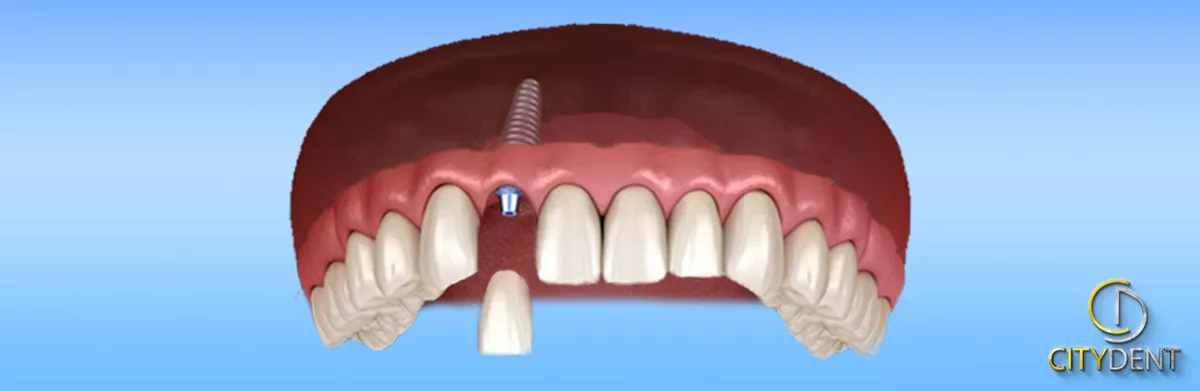
How Many Dental Implants Do I Need?
This question is one of the most common in implant dentistry, and the answer is: it depends on your specific bone volume, the number and location of missing teeth, and the prosthetic solution you and your clinician agree on. Patients often ask how many dental implants do I need before imaging — a valid question, but one that can only be answered definitively after a 3D scan.
For patients missing one tooth, one implant is typically all that is required. For patients missing several adjacent teeth, one or two implants can support a bridge spanning three or four crowns. For patients who have lost most or all of their teeth, four to eight implants per jaw can anchor a full fixed prosthesis. Whether you need implants for missing teeth in a single region or across the entire arch, your clinician determines the minimum number that achieves stability and function.
The clearest path to knowing how many dental implants do I need is a panoramic X-ray reviewed alongside a 3D CBCT scan. These give your clinician bone height, width, density, and the precise position of nerves and sinuses. At Citydent Istanbul, this diagnostic step is provided at no cost as part of your initial consultation. Understanding dental implant basics makes it easier to understand why some patients need two implants while others need six or more.
Upper Jaw — How Many Implants Are Needed?
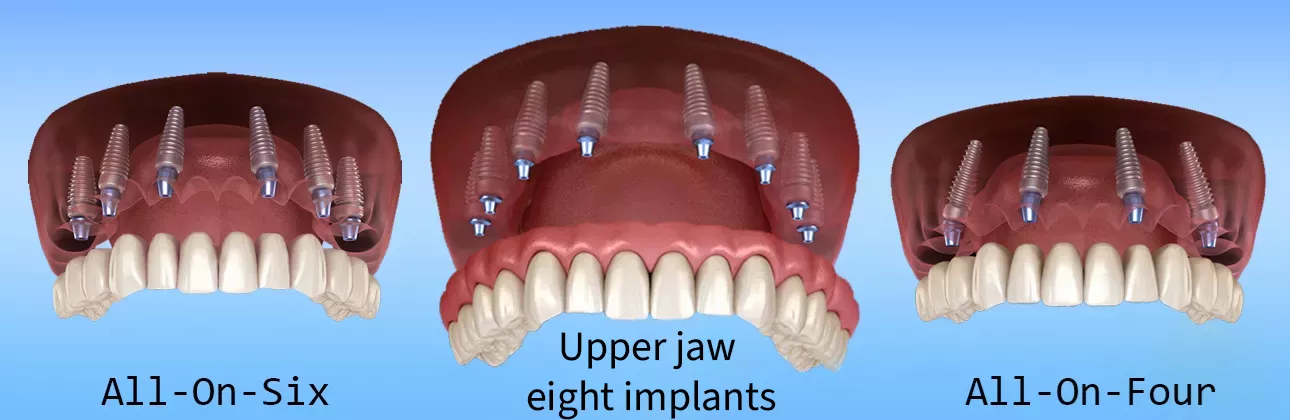
The upper jaw (maxilla) has softer, more porous bone than the lower jaw, which means it generally requires more implants to achieve long-term stability. For full arch rehabilitation, the number of implants needed in the upper jaw typically ranges from four to eight, depending on individual bone quality and prosthetic design.
All-on-4 Upper Jaw
Four implants — two placed vertically at the front and two placed at an angle toward the back — support a fixed full-arch prosthesis. This approach reduces the need for bone grafting and offers a same-day teeth solution for patients with moderate upper jaw bone volume. Systematic reviews confirm high survival rates when patient selection criteria are met.
All-on-6 Upper Jaw
Six implants distribute the load more evenly across the arch. This is preferred when the upper jaw has slightly reduced posterior bone or when a more rigid prosthetic platform is clinically indicated. The additional implants improve force distribution and may reduce long-term prosthetic complications.
8 Implants Upper Jaw
Eight implants offer maximum support for patients with wider arches, low bone density, or complex prosthetic requirements. This configuration is chosen when primary stability demands the highest possible implant count. The position of the maxillary sinus is the primary anatomical factor in upper jaw planning — a 3D scan confirms safe implant zones.
Lower Jaw — How Many Implants Are Needed?
The lower jaw (mandible) has denser cortical bone, which means four implants are often sufficient for a full-arch restoration. Fewer implants are needed here compared to the upper jaw, and primary stability is generally higher.
All-on-4 Lower Jaw
This is among the most frequently used configurations for complete lower jaw rehabilitation. Four implants — placed in the area of highest bone density, between the mental foramina — support a fixed prosthesis with reliable long-term results. Patients who qualify can receive temporary fixed teeth on the day of surgery. For more detail on how this configuration is planned, see All on Four Istanbul.
All-on-6 Lower Jaw
Six implants are used when additional stability is needed — for example, in patients with higher bite forces, patients planning longer-span prosthetics, or those where the posterior implant placement position benefits from extra support. The choice between four and six implants in the lower jaw is made by your implant surgeon after reviewing your scan data and discussing your treatment goals.
Implants for Regional Gaps — Single and Multiple Missing Teeth
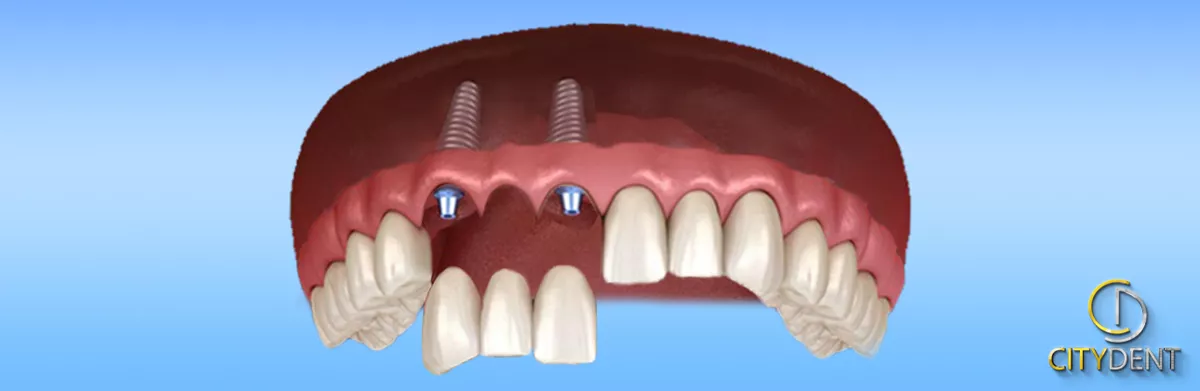
Not all implant cases involve full-arch rehabilitation. Many patients come to Citydent Istanbul with one, two, or several missing teeth in a specific region of the mouth. Whether you are looking at single vs multiple implants for missing teeth, the guiding principle is always the minimum number of implants that achieves stable, functional, aesthetic results.
-
Single missing tooth One implant supports one crown. This is the standard solution for an isolated gap and preserves adjacent teeth without grinding them down for a bridge.
-
Two or three adjacent missing teeth Two implants are typically sufficient to support a three-unit bridge, avoiding the need for an implant at every missing position.
-
Four or more adjacent missing teeth Three or more implants may be needed, depending on gap length, bone volume, and bite load. In some cases, an implant-supported partial arch solution or a segmented bridge is planned.
When neighboring teeth have drifted into the gap or bone has resorbed over time, additional preparation steps may be part of the plan. The Implant type selection guide covers how different implant diameters and lengths are matched to regional gaps. Cases involving bone loss may also be affected by implant age requirements Istanbul reviews that inform the treatment timeline.
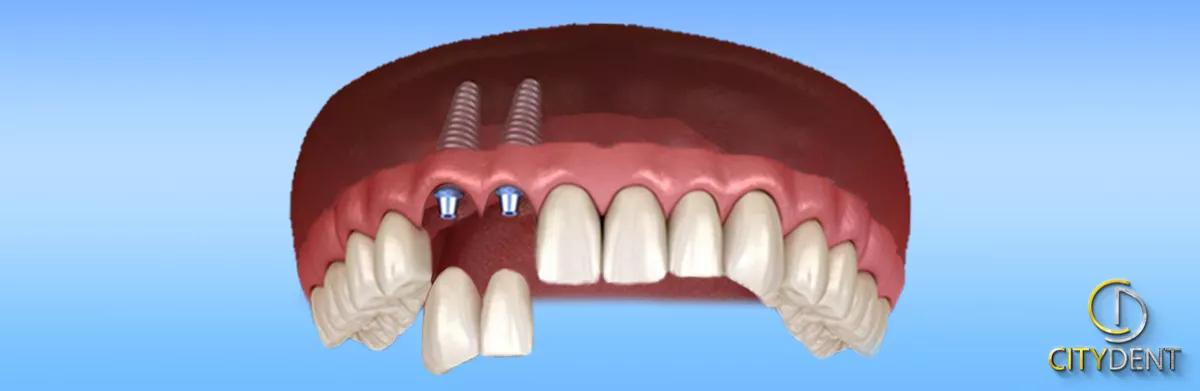
Does Every Missing Tooth Need an Implant?
No — and understanding when an implant is the right solution versus when it is not is an important part of your planning conversation with your clinician. Several factors determine whether a specific gap needs an implant or whether another approach is more appropriate.
-
Bone availability Insufficient bone volume without feasible grafting may rule out implant placement in that position.
-
Tooth location Non-functional positions such as third molars are not typically restored with implants.
-
Gap size Very narrow gaps may not accommodate standard implant dimensions safely without risking adjacent tooth roots.
-
Patient preference Some patients choose traditional fixed bridges or removable prosthetics for personal, financial, or health reasons.
-
Long-term planning If neighboring teeth are at risk of future loss, the implant plan may be designed to accommodate potential additional gaps rather than treating each site in isolation.
A panoramic X-ray and CBCT scan remain the only reliable way to assess which gaps are suitable for implants. Your clinician at Citydent dental clinic Istanbul will walk you through the assessment at your free consultation.
How Many Implants Are Needed for Full Mouth Restoration?
Full mouth restoration requires the most precise planning when it comes to knowing how many dental implants do I need across both jaws. The number of implants depends on whether you are restoring one jaw or both, and which prosthetic system is chosen. Knowing how many implants full mouth cases require helps patients plan realistically — both clinically and financially.
| Restoration Type | Implants per Jaw | Teeth Restored |
|---|---|---|
| All-on-4 | 4 | 10–12 prosthetic teeth |
| All-on-6 | 6 | 12–14 prosthetic teeth |
| Full set (one implant per tooth) | 14–16 | 14–16 individual crowns |
| Mixed (bridge + single crowns) | Variable | Per clinical plan |
For patients restoring both jaws simultaneously, the total implant count typically ranges from 8 to 16 or more. The choice of system directly affects implant cost by number Istanbul, as each implant involves a surgical stage, abutment, and prosthetic component.
The implant count Istanbul patients receive for full mouth cases is confirmed only after the 3D CT scan is reviewed. Estimates provided before imaging are directional only. For a detailed overview of full arch rehabilitation, visit our page on full set implants Istanbul.
Frequently Asked Questions
-
How is the number of implants determined for each patient?
Bone structure, gum health, and your aesthetic and functional needs are evaluated using panoramic X-rays and 3D CT scans. This allows for a fully personalised plan. No two patients have identical bone anatomy, which is why imaging is the foundation of every implant number decision. -
Do I need an implant for every missing tooth?
No. Thanks to implant-supported bridges, one implant can often replace two or even three teeth. The specific number depends on gap length, bone volume, and the prosthetic design your clinician recommends. -
Can implants be placed if I have bone loss?
Yes. In cases with reduced bone density, techniques such as angled implants, bone grafting, or All-on-4/6 may be used to ensure long-term stability. Your scan will determine which approach is appropriate for your specific anatomy. -
Can I get a full set of teeth with just a few implants?
Yes. Techniques like All-on-4 or All-on-6 allow 10–14 prosthetic teeth per jaw with just four or six implants. These are fixed, non-removable solutions anchored directly into the jawbone. -
Is a CT scan really necessary before deciding how many implants I need?
Yes. A CT scan provides critical 3D information on bone height, width, density, and the position of nerves and sinuses. This is the only way to plan implant count and placement with precision and safety. At Citydent, this scan is provided free of charge at your first consultation.