Dental CBCT Scan & X-Ray in Istanbul
Advanced 3D imaging and digital panoramic x-rays at Citydent Istanbul — reviewed immediately by your attending dentist, integrated within your first consultation.
Imaging is included as part of your initial consultation visit. No separate appointment required.
What Is a Dental CBCT Scan?
CBCT stands for Cone Beam Computed Tomography. Unlike a conventional dental x-ray, which captures a flat two-dimensional image, a CBCT scan produces a three-dimensional reconstruction of your teeth, jawbone, sinuses, and surrounding anatomical structures.
In practice, this means your dentist can examine bone density at specific implant sites, trace the exact path of the inferior alveolar nerve before a complex extraction, or assess root canal anatomy that standard x-rays cannot fully reveal.
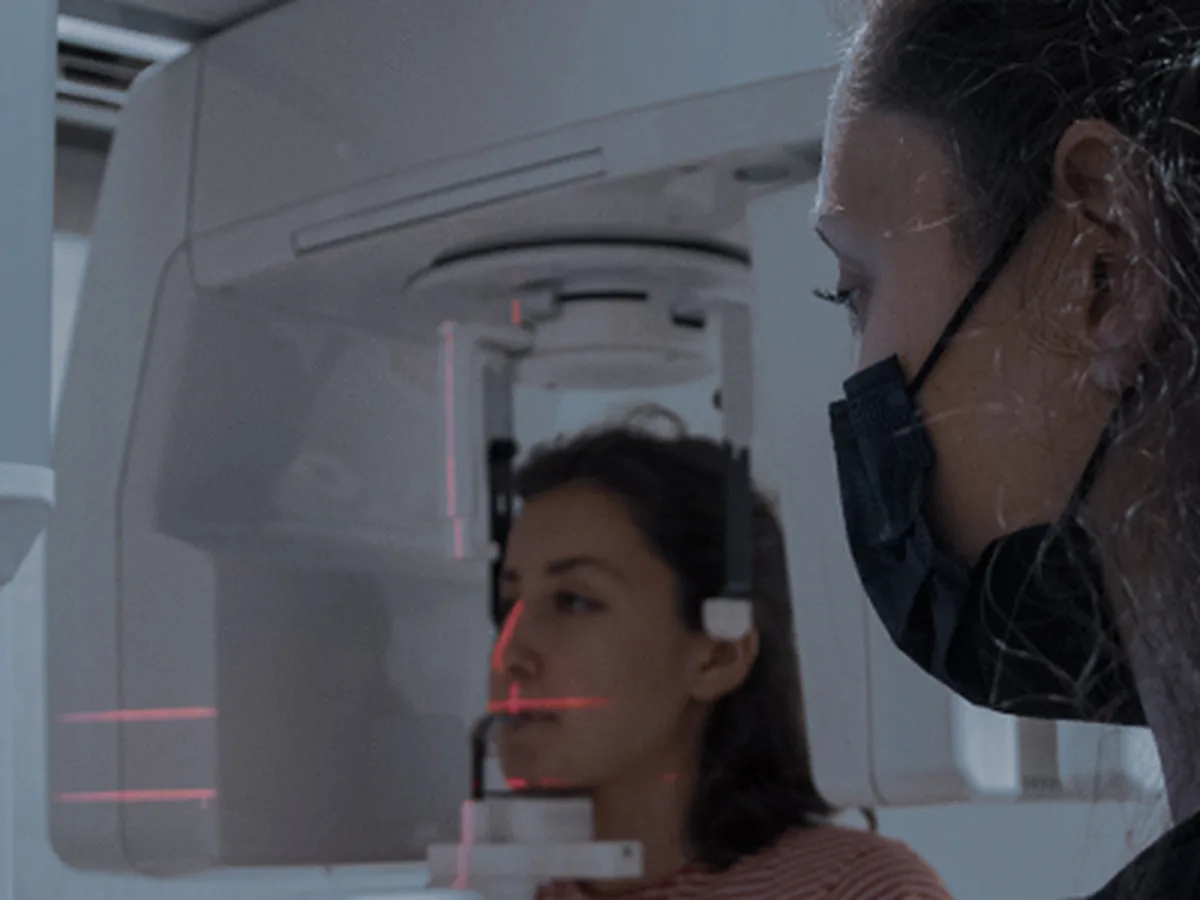
The scan itself takes less than a minute. The patient stands or sits while a rotating arm captures multiple projections, which are then assembled into a volumetric dataset. The result is a precise, layered view of hard tissue that guides treatment planning with millimetric accuracy.
Citydent Istanbul uses in-house CBCT imaging. Scans are reviewed immediately by your attending dentist — and where complex anatomy requires specialist input, by our maxillofacial radiology consultant.
Panoramic X-Ray vs CBCT: When Is Each Used?
Both imaging types serve distinct clinical purposes. A panoramic x-ray provides a broad overview of the entire dental arch in a single two-dimensional image — valuable for initial assessments, orthodontic evaluation, and general dental check-ups. It captures all teeth, the jaw joints, sinuses, and surrounding bone in one frame.
A CBCT scan is indicated when three-dimensional data is essential: implant planning, surgical extractions near nerve structures, root canal treatment in complex anatomies, or evaluation of cysts and pathological bone changes.
At Citydent, the choice between a panoramic x-ray and a CBCT scan in Istanbul is made by your dentist based on your clinical presentation — not as a default protocol. You will always be informed of the reason for each imaging request before it proceeds.
Conditions That Require a Dental CBCT Scan
CBCT imaging is typically indicated for the following:
-
Dental implant planning Bone volume, density, and proximity to anatomical boundaries are assessed in three dimensions before implant placement. Accurate CBCT data reduces surgical risk and allows for precise implant positioning — a standard part of our implant treatment process.
-
Wisdom tooth extraction When lower wisdom teeth lie close to the inferior alveolar nerve, a CBCT scan provides the spatial detail needed to plan a safe extraction and discuss associated risks with the patient before tooth removal proceeds.
-
Root canal treatment CBCT imaging reveals root canal morphology that a standard periapical x-ray may not show: additional canals, root curvatures, and periapical lesions are identified more reliably, supporting more predictable outcomes in root canal treatment Istanbul.
-
Orthodontic evaluation Skeletal relationships, tooth inclinations, and impacted teeth are assessed in three dimensions to support accurate orthodontic diagnosis and treatment planning.
-
TMJ analysis The temporomandibular joints are evaluated in cross-section, offering diagnostic detail not achievable with panoramic imaging alone.
-
Sinus assessment For patients requiring CBCT scan for sinus lift Istanbul, CBCT data shows sinus floor height and membrane condition in detail, directly informing surgical strategy.
The CBCT Scan Process at Citydent Istanbul
A dental CBCT scan Istanbul patients receive at Citydent is integrated within your consultation visit — no separate appointment is needed. Scans are performed and reviewed on the same day.
The process follows a consistent clinical sequence:
- 01 Your dentist reviews your dental history and clinical presentation.
- 02 Where imaging is indicated, the appropriate scan type is selected and explained to you before it proceeds.
- 03 The scan is performed by our trained radiology technician. The procedure is painless and typically completed within a few minutes.
- 04 Images are reviewed immediately and discussed with you during the consultation.
- 05 A printed treatment plan, based in part on your imaging findings, is prepared before any treatment commences. This plan is reviewed and signed by both parties.
Patients who proceed with treatment receive a copy of their imaging — either as a digital file or printed format — at no additional charge.
For patients travelling from abroad for dental implant planning in Istanbul, CBCT imaging forms a central part of the pre-treatment assessment, typically completed on the first day of the visit.
Radiation Safety and Digital Imaging
Dental CBCT scans use significantly lower radiation doses than conventional medical CT scans. The dose delivered is comparable to a small number of standard periapical x-rays and substantially below the threshold associated with any clinical concern.
At Citydent, imaging is requested only when clinically justified. No imaging is performed as a routine or administrative procedure. Lead aprons and thyroid collars are available and used as standard precaution.
Digital panoramic x-rays at our clinic use direct sensor technology, which reduces radiation exposure compared to film-based systems. Images are stored securely in your digital patient file and can be shared with you or your referring practitioner upon request.
If you have questions about a specific imaging recommendation, your dentist will explain the clinical rationale before any scan proceeds. You may also book a consultation to discuss your imaging needs in advance of your visit.
Frequently Asked Questions
-
Is a CBCT scan necessary before every dental implant?
In most cases, yes. CBCT imaging provides the three-dimensional bone assessment required for accurate implant positioning. In straightforward single-tooth cases with adequate bone, a panoramic x-ray may sometimes be sufficient — your dentist will determine the appropriate imaging based on your clinical situation.
-
Does the CBCT scan hurt?
No. The scan is entirely non-invasive. You remain still while the imaging arm rotates around your head. There is no physical contact with teeth or soft tissue during the procedure.
-
How long does the scan take?
The active scanning time is typically under one minute. Including positioning and the technician's preparation, the full procedure is usually completed within five to ten minutes.
-
Can I receive a copy of my CBCT scan?
Yes. Patients proceeding with treatment at Citydent receive a copy of their imaging in digital or printed format. If you would like your images transferred to another practitioner, our team can facilitate this.
-
Are dental x-rays safe during pregnancy?
Pregnant patients should inform their dentist before any imaging is requested. In most cases, routine dental x-rays are deferred until after delivery unless clinically urgent. Your dentist will make the appropriate recommendation based on your individual circumstances.
-
What is the difference between a periapical x-ray and a panoramic x-ray?
A periapical x-ray captures one or two individual teeth in detail and is used to assess roots, bone levels around specific teeth, and periapical pathology. A panoramic x-ray captures the full dental arch in a single image and is used for broader diagnostic assessments.
-
Do I need to prepare anything before a dental CBCT scan in Istanbul?
No special preparation is required. You will be asked to remove metal jewellery, glasses, and any removable dental appliances before the scan. There are no dietary restrictions.