Guided Surgery Implants Istanbul
Computer-guided implant surgery combines CBCT imaging with digital planning software to place each implant precisely where anatomy and function demand — reducing invasiveness and increasing predictability for patients travelling to Istanbul.
What Is Guided Implant Surgery?
Guided implant surgery — also called computer-guided implant surgery Istanbul — is a technique in which a three-dimensional CBCT scan of the jaw is used to plan implant positions before the procedure begins.
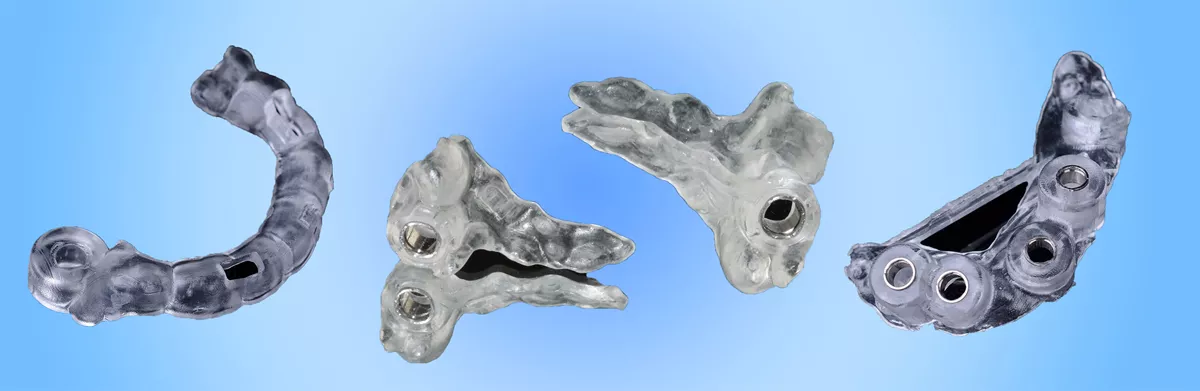
That plan is then exported into a custom surgical guide: a precise, patient-specific device that fits over the gums and directs the drill to the planned position, angle, and depth during surgery.
The result is precision implant placement Istanbul that reflects pre-operative planning rather than intraoperative estimation. The surgeon knows exactly where each implant will go before the first incision is made. Guided surgery implants Istanbul reduces the variables that arise from in-chair decision-making.
How the Planning Process Works
The workflow for digital implant surgery Turkey follows a defined sequence, from scanning through to the guided placement appointment.
-
CBCT scan A cone-beam CT scan produces a full 3D model of the jaw, showing bone volume, density, and the location of anatomical structures such as the inferior alveolar nerve and sinus floor.
-
3D planning software The implant team works within digital planning software to select implant dimensions and simulate placement in the virtual model, optimising position, angle, and prosthetic outcome.
-
Surgical guide fabrication The approved plan is exported and used to manufacture a printed surgical guide. The guide contains sleeve openings that constrain the drill path to the planned trajectory.
-
Guided placement During surgery, the guide is seated in the mouth and each implant is placed through the guide sleeve. Deviation from the planned position is minimised.
This sequence, sometimes called CBCT guided implant Istanbul, is the standard approach for complex cases and for patients where anatomical proximity to vital structures requires an additional safety margin.
Who Is a Candidate for Guided Surgery?
Not every implant case requires a surgical guide. Patients who are good candidates for guided surgery implants Istanbul typically present with one or more of the following conditions:
- Available bone volume is limited and precise depth control is critical
- Implants are planned near the inferior alveolar nerve or maxillary sinus
- Multiple implants are required and parallel alignment directly affects the prosthetic outcome
- A flapless or minimally invasive approach is planned — surgical guides make Flapless Implant Istanbul reproducible
- Initial 2D imaging has identified anatomical complexity warranting 3D planning
For straightforward single-tooth cases with adequate bone and clear anatomy, conventional placement may be appropriate. Your assessment at Citydent will determine the most suitable approach for your case, and your treatment plan will be presented to you in writing before any procedure begins.
Guided vs Conventional Implant Surgery
The primary distinction between guided surgery dental implants and conventional placement is planning methodology.
Guided Surgery
Guided surgery implants Istanbul — planning is completed in 3D before the procedure. The surgical guide physically constrains drill movement to the planned path. Less intraoperative adjustment is required.
Conventional Surgery
Planning relies on 2D radiographs and clinical assessment. Implant positioning is guided by the surgeon's judgement during the procedure. This approach is well-established and appropriate for many cases.
Both methods, when properly executed, can achieve successful osseointegration. The case type, bone anatomy, and prosthetic requirements determine which approach is most suitable — a decision made during your clinical assessment and CBCT review.
Guided Implant Surgery at Citydent Istanbul
At Citydent Istanbul, guided surgery implants Istanbul cases begin with an on-site CBCT scan, digital planning review, and written treatment plan. The surgical guide is fabricated before your procedure date, so planning work is completed before you arrive for surgery.
For international patients, guided surgery implants Istanbul provides a clear framework for scheduling. Cases that combine guided placement with a flapless technique — which avoids incisions and sutures — may offer a shorter recovery period, depending on the number of implants and the complexity of your case.
Our team uses digital implant technology Istanbul to integrate CBCT data, planning software, and surgical guide production within a single workflow. This is the same infrastructure that supports our broader range of tooth implants Istanbul treatments and our work at our dental clinic Istanbul.
If your case also involves a flapless technique, see our dedicated page on Flapless Implant Istanbul or single stage guided implant Istanbul for cases where the implant and abutment are placed in a single visit. For prosthetics, we also offer custom abutment Istanbul fabrication to ensure the restoration fits the guided placement position precisely.
If you would like to understand whether guided surgery is the right approach for your case, contact our team for a free consultation.
Guided Surgery Implants — FAQ
What is the difference between guided implant surgery and regular implant surgery?
Guided surgery implants Istanbul uses a CBCT-derived 3D plan and a custom surgical guide to constrain drill movement to a pre-planned path. Conventional implant surgery uses the surgeon's clinical assessment and 2D imaging to determine position intraoperatively. Both approaches are established; the choice depends on bone anatomy, case complexity, and prosthetic requirements.
Is CBCT scanning necessary before guided surgery?
Yes. A CBCT scan is required because it provides the 3D bone map from which the digital plan and surgical guide are generated. According to AAP evidence review guidance, CBCT is indicated when standard two-dimensional imaging is insufficient for accurate implant planning. At Citydent, CBCT imaging is available on-site.
Does guided implant surgery hurt less than conventional surgery?
Pain experience depends on the individual, anaesthesia, and the extent of the procedure — not solely on whether a guide was used. Guided surgery combined with a flapless technique can reduce tissue trauma in qualifying cases. Your dentist will advise on what to expect for your specific treatment plan.
How accurate is computer-guided implant placement?
Published studies on computer-guided implant surgery report clinically acceptable deviations from the planned position, with angular deviations typically within a few degrees and depth deviations within approximately 1 mm. Accuracy depends on the quality of the CBCT data, software planning, and guide fabrication. Cases with multiple implants or complex anatomy benefit most from the predictability of guided placement.
Is guided surgery available for all implant types at Citydent Istanbul?
Guided surgery implants Istanbul can be applied to single-tooth cases, multiple-implant cases, and full-arch reconstructions. Whether it is appropriate for your case is determined during your clinical assessment and CBCT review at Citydent.
How long does the guided surgery planning process take?
After your CBCT scan, digital planning and surgical guide fabrication typically take one to two weeks before your procedure date. For patients scheduling treatment from abroad, your Citydent coordinator will include this preparation time in your appointment schedule.
Can I combine guided surgery with a flapless approach?
In selected cases, yes. Flapless implant placement guided by a surgical guide avoids incisions and sutures. Eligibility depends on available bone volume, soft tissue anatomy, and the number of implants. Your Citydent assessment will confirm whether this approach is suitable for you.
Sources reviewed: Rios HF, Borgnakke WS, Benavides E. "AAP Best Evidence Review: Use of CBCT in Implant Management." Journal of Periodontology, 2017. PMID:28967330. pubmed.ncbi.nlm.nih.gov/28967330