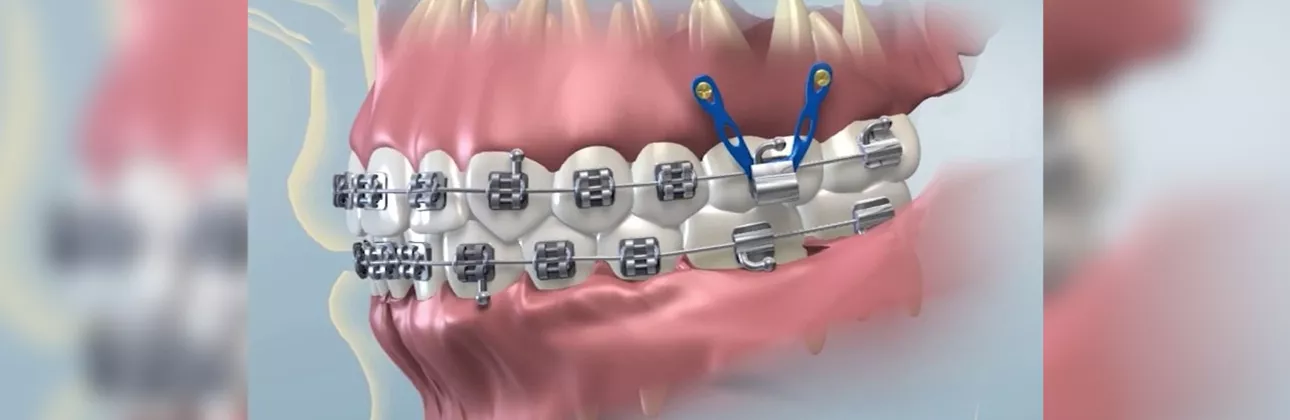
Orthodontic implants — known clinically as temporary anchorage devices (TADs) — are small titanium screws placed temporarily into the jawbone to serve as fixed anchor points during orthodontic treatment. Unlike conventional dental implants, they are not designed to support a crown or bridge: they exist solely to help the orthodontist move teeth with greater precision and control. At Citydent, orthodontic implant Istanbul cases are planned as part of a full orthodontic assessment. The procedure is straightforward, minimally invasive, and reversed once the tooth movement is complete.
What Is an Orthodontic Implant?
An orthodontic implant — or TAD (Temporary Anchorage Device) — is a 1.5 to 2 mm titanium screw placed into the cortical bone between tooth roots. It acts as an immovable anchor while elastic force is applied to move specific teeth.
Before TADs, orthodontists relied on neighbouring teeth as anchors. This created a limitation: when you pull against a tooth to move another, the anchor tooth may shift slightly. TADs eliminate this problem entirely — they do not move under orthodontic force, giving the orthodontist full mechanical control.
Because orthodontic implant Istanbul treatment at Citydent is integrated into the overall ortho plan, the device is placed only when needed and removed once its role is complete — typically a five-minute procedure under local anaesthetic.
When Is an Orthodontic Implant Used in Istanbul?
- Closing large post-extraction gaps without allowing molars to drift forward
- Pulling impacted or partially erupted teeth into the correct position
- Intruding over-erupted teeth before restorative work
- Correcting deep bites where anterior intrusion is required
- Supporting tooth movement in clear aligner cases when certain movements exceed aligner biomechanics alone
- Preventing unwanted tooth movement in complex multi-bracket cases
For patients considering clear aligner treatment at Citydent Istanbul, your orthodontist will assess whether TAD support is indicated. Research shows clear aligners are effective for mild to moderate malocclusion — but in cases requiring precise molar control or vertical movement, an orthodontic micro implant provides the anchor that aligners cannot generate independently.
Mini implant orthodontics Istanbul cases are among the most common referrals to our implant team. When the orthodontic implant Istanbul treatment plan calls for TAD anchorage, our team coordinates placement and removal around your orthodontic appointments.
The Orthodontic Implant Procedure at Citydent Istanbul
Placement of a temporary anchorage device Istanbul is a brief, comfortable procedure. Here is how it works at Citydent:
-
Assessment and planning A CBCT scan identifies the ideal inter-radicular site — the space between roots where the TAD can be placed safely without contacting tooth structure. This ensures precise, safe positioning.
-
Placement Under local anaesthetic, the titanium screw is gently threaded into the cortical bone. No incision is required in most cases. The procedure takes under ten minutes per TAD.
-
Activation Once placed, elastic chains or springs are connected between the TAD and the teeth to be moved. Your orthodontist adjusts the force at each appointment.
-
Removal When the prescribed movement is achieved, the TAD orthodontics Istanbul phase concludes and the orthodontic implant is removed — a quick, painless procedure. The site heals completely within two to four weeks, with no permanent restoration required.
Mini Implant vs Standard Dental Implant
Patients sometimes confuse orthodontic micro implants with conventional dental implants. They are fundamentally different devices:
| Feature | Orthodontic Implant (TAD) | Conventional Dental Implant |
|---|---|---|
| Purpose | Anchor for tooth movement | Replace a missing tooth |
| Diameter | 1.5–2 mm | 3.5–5 mm |
| Duration | Temporary — removed after treatment | Permanent |
| Restoration | None — anchor only | Crown, bridge, or prosthesis |
| Osseointegration | Cortical bone engagement only | Full osseointegration required |
| Bone graft needed? | No | Sometimes — case dependent |
If you are looking for options to replace a missing tooth, see our dental implant procedure Istanbul page for the conventional treatment path.
What to Expect: Recovery After Orthodontic Implant Istanbul
Recovery after TAD placement is minimal. Most patients experience mild soreness for one to two days. Oral hygiene around the TAD site is important — gentle brushing with a small-headed toothbrush and thorough rinsing keeps the site clean and reduces the low risk of local irritation. Your treating dentist can advise on any pain relief appropriate for you.
Evidence from orthodontic research supports that maintaining good gingival health throughout active treatment contributes to better long-term outcomes, particularly with fixed appliances.
Your orthodontic implant Istanbul treatment at Citydent is coordinated between the implant clinician and the treating orthodontist. The device is activated at the right phase of treatment, maximising efficiency and minimising overall duration. The site heals completely within two to four weeks after removal — no restoration is needed.
Orthodontic Implant Istanbul — Key Points
- TADs are small, temporary titanium screws used solely as orthodontic anchors — no crown, no permanent restoration
- Placed between tooth roots in a brief, minimally invasive procedure under local anaesthetic
- Removed once the prescribed tooth movement is complete — site heals within weeks
- Used in bracket, aligner, and mixed-appliance orthodontic cases
- Indicated when conventional anchoring is insufficient for the planned movement
- Available at Citydent as part of integrated orthodontic treatment in Istanbul with our orthodontist Istanbul
Frequently Asked Questions — Orthodontic Implant Istanbul
Is an orthodontic implant the same as a dental implant?
No. An orthodontic implant (TAD) is a small temporary screw used to anchor tooth movement during braces or aligner treatment. It is removed after treatment and requires no crown or restoration. A conventional dental implants Istanbul solution is a permanent fixture used to replace a missing tooth and requires osseointegration and a crown.
How long does an orthodontic implant stay in place?
A TAD stays in for as long as the specific tooth movement requires — typically a few months to over a year, depending on the complexity of your case. Your orthodontist at Citydent Istanbul will remove it once the target position is reached.
Is TAD placement painful?
Placement is performed under local anaesthetic and takes under ten minutes in most cases. Mild soreness at the site is normal for one to two days. Most patients describe the experience as considerably less uncomfortable than a standard tooth extraction. Your treating dentist can advise on any pain management appropriate for your situation.
Can orthodontic implants be used with clear aligners?
Yes. When specific movements exceed what aligners can achieve independently — such as significant vertical movement or molar intrusion — an orthodontic micro implant Istanbul provides the additional anchorage needed. This combination is increasingly used for complex aligner cases and is assessed at your consultation.
Will I need a bone graft for an orthodontic implant?
No. TADs engage only the cortical (outer) layer of bone and do not require full osseointegration. Bone grafting is not indicated for orthodontic implant placement. This is one of the key differences from conventional dental implants, which may require grafting in cases of bone deficiency.
What happens to the site after the TAD is removed?
After removal, the small puncture site heals quickly — typically within two to four weeks. No restoration is needed. Standard oral hygiene care during healing is sufficient. Your orthodontist will advise on any specific post-removal instructions.