What Shade Are My Teeth?
Your natural tooth color is shaped by genetics, age, and enamel thickness. Understanding where your shade sits is the first step when considering whitening, veneers, or zirconia crowns.
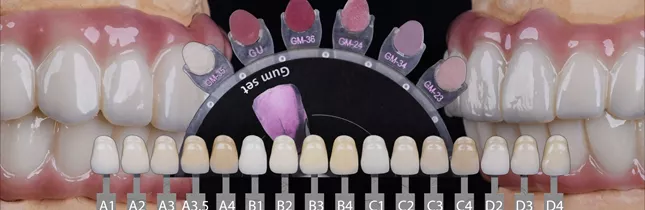
Understanding Your Natural Tooth Color
Every person's natural tooth color is inherited at birth, much like skin tone or eye color. The tooth's visible shade comes primarily from the dentin layer beneath the enamel: dentin is naturally yellowish, and as enamel thins with age, that underlying tone becomes more apparent.
Several factors influence natural tooth color:
-
Genetics The thickness and translucency of your enamel are largely inherited — your baseline shade is set before lifestyle plays a role.
-
Age Enamel gradually wears over time, making teeth appear darker as the warmer dentin layer beneath becomes more visible.
-
Diet Coffee, tea, red wine, and certain spices stain enamel progressively through repeated exposure.
-
Smoking Nicotine and tar cause both surface and subsurface discoloration that can be difficult to fully reverse with whitening alone.
-
Medications Certain antibiotics taken during tooth development can permanently affect natural tooth color from within the dentin structure.
What Determines Your Natural Tooth Color?
The dentin-to-enamel ratio is the primary driver of visible shade. Teeth with thicker enamel tend to appear whiter because light reflects from the surface rather than transmitting through to the dentin below. As enamel thins — through aging, acidic foods, or wear — the warmer dentin color shows through more clearly.
Internal factors such as past trauma or certain systemic medications can also darken individual teeth independently of the rest, which is why a single tooth sometimes looks noticeably different from its neighbors.
Does Tooth Color Change Over Time?
Yes, gradually. Enamel thinning and surface staining accumulate across decades, meaning that a natural tooth shade that appeared light ivory in your twenties may read as light yellow by your forties. This is a normal biological process. Regular professional cleaning removes surface deposits that accelerate the visual shift, while professional whitening can address the staining component — though it cannot reverse enamel thinning itself.
How to Identify Your Tooth Shade
Identifying your natural tooth color accurately requires a controlled environment. Artificial lighting, camera filters, and reflected color from clothing or lipstick all skew the result. Clinics use standardized tools to eliminate these variables.
Home Methods: Mirror, Paper, and Charts
A rough estimation is possible at home using natural daylight:
- Hold a sheet of plain white paper next to your teeth in natural daylight — this gives a neutral reference point
- Compare your teeth against a natural tooth color chart or printed VITA shade guide, not fluorescent or warm indoor lighting
- Photograph your smile against the white paper and compare the image to a digital shade reference
These methods provide a general bracket but are not precise enough for treatment planning. Shade matching for veneers or crowns requires in-clinic measurement.
Using a Photo or AI Tool to Check Your Shade
Several mobile applications and dental software tools now allow patients to upload a smile photograph and receive a suggested VITA shade. When people ask what shade are my teeth, this is one accessible way to get an initial answer. When using these tools:
- Photograph in natural daylight with no filters applied
- Keep lips relaxed and gums visible — lip shadow distorts the perceived color
- Use the same white-paper reference method alongside the photo for context
AI-based shade tools are improving, but results should be confirmed in clinic before any treatment decision is made. For more detail on shade selection for restorations, see our tooth color selection guide.
Natural Tooth Color Chart — VITA Shade Guide
The most widely used clinical reference for natural tooth color is the VITA Classical Shade Guide, which groups shades into four families. The majority of untreated adult teeth fall between A2 and A3 — a light-to-medium warm ivory. A2 teeth color is considered an average natural baseline for adults. Shades such as B1 tooth color or 1M1 tooth shade (VITA 3D-Master) represent the lighter end of the natural range and are often referenced as whitening targets.
For restorations, digital shade scanners measure hue, chroma, and value simultaneously — providing greater precision than visual matching alone.
Shade Variation: Are All Teeth the Same Color?
No. Even within a healthy, untreated mouth, individual teeth typically vary in natural tooth color. This is normal and expected. Key patterns include:
When fabricating veneers or zirconia crowns, ceramic technicians replicate these gradients using layered ceramics — ensuring the restoration appears natural rather than flat or opaque. Shade matching during cosmetic treatment is done tooth by tooth, not assumed uniform across the arch.
Can My Natural Tooth Shade Be Improved?
Whether — and how — a natural tooth color can be improved depends on the cause and extent of discoloration.
Professional Whitening Options
External staining from coffee, tea, wine, or tobacco responds well to professional whitening. Options include in-office bleaching sessions, take-home tray systems with dentist-prescribed gels, and combined protocols. Results are most predictable on healthy enamel with surface staining. Whitening does not affect existing restorations — fillings, crowns, or veneers will not lighten with bleaching agents.
For more information on available whitening protocols, visit our teeth whitening page.
When Veneers or Crowns Are the Right Choice
For deeper discoloration — from internal staining, past trauma, or enamel defects — whitening alone is typically insufficient. In these cases, porcelain veneers or zirconia crowns provide a stable, long-term color outcome. Monolithic zirconia in particular offers excellent color stability over time.
If you are restoring only a few teeth, matching closely to your existing natural tooth color is important. If you are planning a full-arch makeover, there is more latitude to select a lighter, more uniform shade. A consultation allows your dentist to map your current shades and discuss what each approach can realistically achieve.
For professional cleaning that removes surface deposits before any shade assessment, see our teeth cleaning page.
Common Questions About Natural Tooth Color
Are naturally white teeth common?
Not particularly. Most people's natural tooth color falls within shades of ivory, light yellow, or pale grey. Clinically white teeth — such as shade B1 or lighter — are at the lighter end of the natural range and relatively uncommon without cosmetic treatment.
Can natural tooth color be completely changed?
The underlying tone established by your dentin cannot be altered by whitening. Whitening can remove surface staining and lighten enamel somewhat, but for a significant change in natural tooth color, veneers or crowns are typically required.
Do genetics determine my tooth color?
Yes — enamel thickness, dentin shade, and translucency are largely inherited. Lifestyle factors such as diet and smoking modify the starting point over time, but the baseline is genetic.
Why do my teeth look darker than they used to?
Aging, staining foods, and progressive enamel thinning all contribute to a gradual shift in visible tooth shade. This is a normal biological process.
Will professional whitening damage my tooth structure?
Professional whitening supervised by a dentist is considered safe when used according to protocol and does not structurally damage enamel.
Can I restore my childhood tooth shade?
Professional whitening may come close, depending on the cause of change. Where enamel has thinned with age, however, the visible warmth is structural — not a stain — and whitening will not fully reverse it.
Do natural teeth have uniform color?
No. Different teeth vary in shade, and each individual tooth has subtle internal gradients. This variation is what gives a natural smile its depth and character.
Are natural-looking results achievable with cosmetic dentistry?
Modern ceramic materials and digital shade-matching techniques allow restorations to replicate the translucency, texture, and shade gradients of natural teeth with a high degree of accuracy.