Color & Aesthetic Problems with Implant-Supported Crowns
Implant-supported crowns are designed to look and function like natural teeth — but implant crown color and aesthetic problems are among the most common concerns that arise after crown placement. This guide explains why these issues occur, what your options are, and when a clinical assessment in Istanbul is the right next step.
Food Getting Trapped Around an Implant Crown
Food accumulation around an implant crown is not simply an inconvenience. It can indicate a fit problem or early gum irritation that warrants a professional check-up.
Signs to look out for:
- A persistent bad taste or odour shortly after eating
- Food particles consistently dislodged when flossing around the crown
- Gum redness, soreness, or minor bleeding near the crown edges
- Repeated food impaction in the same area
What helps day-to-day:
- Gentle brushing with a soft toothbrush after meals
- Interdental brushes or an oral irrigator to clear debris around the crown
- Antibacterial rinse to limit bacterial accumulation
If food trapping continues despite thorough cleaning, the crown fit or contour may need professional review. This is particularly relevant for implant crown aesthetics in Istanbul where the standard of fit verification has become more precise with digital workflows.
Odour Around an Implant Crown
An unpleasant smell around an implant crown is usually a sign that bacteria or debris has accumulated — either under the crown, in the gum pocket, or around a loose abutment screw.
Common causes:
- Food debris lodged in a gap between the crown and gum
- Gum inflammation causing sulcular odour
- A crown that is not fully sealed against the abutment
- Rarely, a loose or fractured abutment screw
Odour that persists after consistent oral hygiene should be assessed clinically. The source needs to be identified before any intervention. In most cases, a professional clean and fit check resolves the issue without replacing the crown.
Why Does an Implant Crown Look the Wrong Colour?
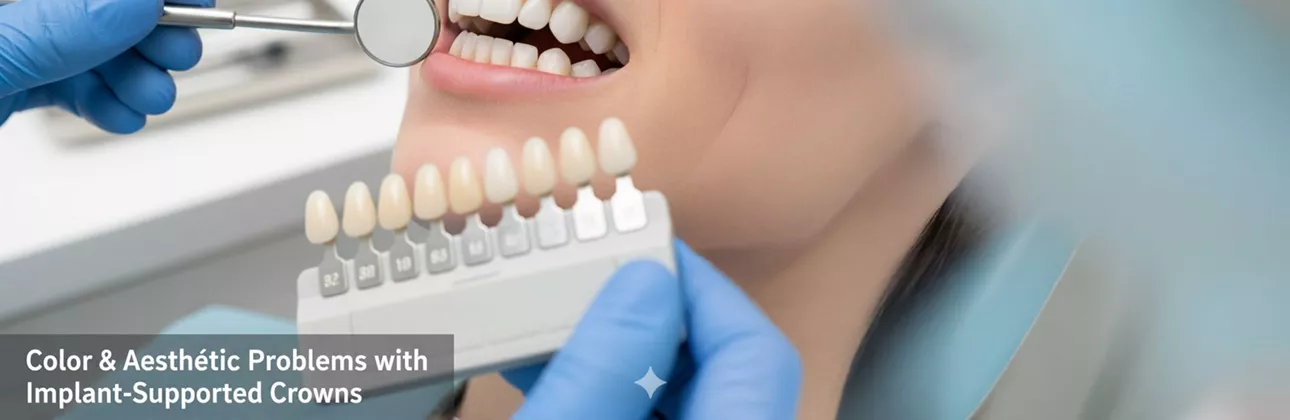
Crown colour mismatch is one of the most frequently reported implant crown color and aesthetic problems. The crown may appear noticeably brighter, darker, or a different hue than the surrounding teeth. A dark crown on implant is particularly obvious in the front teeth and often prompts patients to seek a correction.
Understanding what drives crown colour mismatch implant situations helps set realistic expectations before choosing a treatment path.
Causes of Colour Mismatch After Crown Placement
- Shade selection was carried out under artificial light, which can distort the match
- The patient's natural teeth changed shade after the crown was cemented
- The ceramic material or layering technique did not fully replicate the tooth's translucency
- A monolithic zirconia crown was used in a high-visibility position without surface characterisation
When Is a Colour Difference Worth Treating?
Small shade variations visible only under specific lighting may not require intervention. If the mismatch is noticeable in natural light, especially in the front teeth, replacement is typically the most reliable correction. Crown shade not matching natural teeth is one of the clearest indicators that a remake is necessary. A new crown can be fabricated using digital shade-matching to reduce the risk of a repeated mismatch.
Grey Shadow or Dark Gum Line Around an Implant Crown
A grey crown on implant is among the more visually disruptive implant crown color and aesthetic problems, particularly when it presents as a dark line at the gum margin in the upper front region.
Why This Happens
- A titanium implant placed close to the gum surface showing through thin tissue
- A metal abutment beneath the crown casting a grey hue through the gum
- Gum recession over time, gradually exposing the implant or abutment
- A naturally thin gum biotype that does not conceal the underlying structures
Treatment Options for Grey Gum Lines
Switching from a metal to a zirconia abutment in visible areas addresses the underlying cause in many cases. Where the gum tissue itself is thin or has receded, soft tissue grafting may be considered. The appropriate approach depends on how much tissue is present, the depth of the implant, and the patient's overall aesthetic goals — all assessed during a clinical consultation for implant crown aesthetics in Istanbul.
Why Does an Implant Crown Look Unnatural?
Patients sometimes describe a crown as too white, too bulky, or simply not quite right. These concerns often reflect underlying implant crown color and aesthetic problems that have a clear technical explanation and a practical correction.
Shape, Size and Surface Texture Issues
-
Shade mismatch The crown is noticeably brighter or duller than adjacent teeth
-
Proportion The crown appears wider or longer than the corresponding natural tooth
-
Gum adaptation The crown margin does not follow the natural gum contour
-
Surface texture An overly smooth or flat surface reflects light differently than natural enamel
-
Smile context The crown does not align with the lip line or the overall smile curve
How Crown Aesthetics Are Corrected in Istanbul
Minor issues — such as surface texture or a slight contour adjustment — can sometimes be addressed by reshaping and polishing. When the overall shape, size, or shade are problematic, a full crown remake offers a more predictable result. At CityDent Istanbul, this process typically involves a mock-up or temporary crown to evaluate the result before the final restoration is placed.
Can an Implant Crown Change Colour Over Time?
The ceramic or zirconia material itself does not absorb colour the way natural enamel can — but surface staining and changes in surface quality do occur over time.
Causes of Discolouration
- Surface polish wearing down, leaving the crown more porous and prone to staining
- Regular consumption of coffee, tea, red wine, or tobacco
- Plaque accumulation in areas that are difficult to clean properly
- Lower-grade ceramic materials with less stain resistance
Prevention and Solutions
Maintaining good oral hygiene and attending regular professional cleans will address most surface staining. For significant or persistent discolouration, particularly on older crowns, replacement may give a better long-term outcome than repeated polishing alone.
Can the Crown Be Adjusted Without Full Replacement?
In some cases, yes. Minor adjustments — reshaping an edge, smoothing a surface, or improving the gum contour — can be carried out without fabricating a new crown.
However, if the core issue is a shade mismatch, a significant size or shape discrepancy, or a grey gum line caused by a metal abutment, adjustment alone will not fully resolve the problem. Where implant crown color and aesthetic problems cannot be adequately addressed through adjustments, a new crown is fabricated using current shade data and, where appropriate, a temporary restoration to confirm the result before cementing.
An honest clinical assessment will clarify which option is appropriate for your specific situation. If you have concerns about how your implant crown looks or fits, our team is available for a consultation at CityDent Istanbul.
Frequently Asked Questions
Can I change the colour of my implant crown?
The crown material itself cannot be bleached or lightened. Surface stains can often be reduced through professional polishing, but a crown that is the wrong shade for your teeth will typically need to be replaced to achieve a proper colour match.
What if I am unhappy with how my implant crown looks?
Speak directly with your dentist and describe what specifically bothers you — the colour, shape, size, or the way the crown sits against the gum. A targeted assessment is usually more useful than a general complaint. In many cases, there is a practical correction available.
Do zirconia crowns change colour over time?
Zirconia itself is highly stain-resistant and does not change colour intrinsically. Surface staining from food and drink can accumulate on the polished surface, but this is usually removable with professional cleaning. Significant discolouration is uncommon with high-quality zirconia.
Can implant crowns stain like natural teeth?
They can accumulate surface staining — particularly from coffee, tea, and tobacco — though typically less readily than natural enamel. The key factor is the surface quality of the ceramic or zirconia and how well it is maintained.
How do I explain my aesthetic concerns to my dentist?
Point out the specific issue in a mirror during your appointment — whether it is the colour, the shadow at the gumline, or the shape relative to the adjacent teeth. Clear, specific feedback allows the dentist to identify whether the issue can be corrected and how. If the first appointment does not result in a clear plan, a second opinion from a specialist in implant crown repair Istanbul is entirely reasonable.